
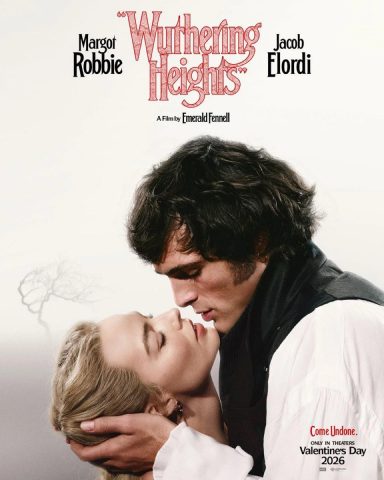
On the Yorkshire moors of the nineteenth century, an obsessive and destructive passion binds Catherine Earnshaw to the foundling Heathcliff across generations. A pop, visually heightened retelling of Emily Brontë's classic, built around love, revenge and class.
After Promising Young Woman, which won her the Oscar for original screenplay, and the divisive success of Saltburn, Emerald Fennell takes on her first major literary adaptation, choosing one of English literature's most beloved and hardest to adapt novels, Emily Brontë's Wuthering Heights. Fennell writes and directs, and also produces through Margot Robbie's LuckyChap Entertainment, with Robbie starring as Catherine opposite Jacob Elordi's Heathcliff, backed by a supporting cast that includes Hong Chau, Alison Oliver and Shazad Latif. The story follows the tormented bond between the two leads, raised together like siblings before class divides them, a love that curdles into obsession and a thirst for revenge capable of consuming two generations of the same family.
Visually, the film deliberately breaks from the traditional British costume-drama mold, with cinematography by Linus Sandgren that multiple critics described as making every frame practically pop off the screen, flamboyant costumes by Jacqueline Durran and original songs by Charli XCX underlining a distinctly pop, almost psychedelic reading of the nineteenth-century text. Critical reception has been sharply polarized, a pattern that has followed Fennell throughout her career, some praised it as an enthralling, accessible retelling of a great love story, while others accused the film of flattening the novel's complexity, reducing Cathy and Heathcliff's tormented bond to a string of sexual encounters dressed up in lavish costumes, stripped of the moral weight and bleakness of the source material. Robbie and Elordi's performances have been praised almost across the board regardless of where reviewers landed on the adaptation itself, with several critics noting that their on-screen chemistry holds even when the script seems to favor visual shock over psychological depth.
Divisive or not, it remains one of the year's most talked-about and most photographed films, recently back in the conversation thanks to a strong commercial run, roughly 242 million dollars worldwide against an 80 million budget, a result that has only fueled the debate around it.

Reader comments
+ add commentNo comments yet. Be the first to write one!