
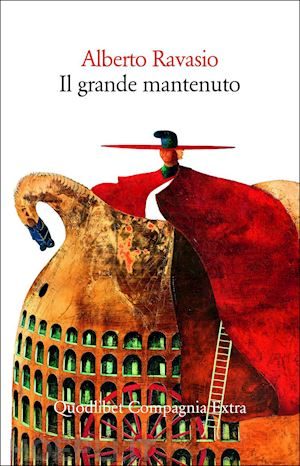
A young graduate who dreams of becoming a writer, born into a family where no one reads, lets himself be kept by whoever comes along the social ladder, from a lesbian couple to a sex worker to the shady publishing world, before falling for a philosophy student from Milan's upper class.
Il grande mantenuto (roughly, The Great Kept Man), published by Quodlibet in its Compagnia Extra series, is the novel that confirms Alberto Ravasio as one of the sharpest voices in recent Italian fiction. Its protagonist is a young graduate with a vague degree, raised in a family where no one reads, who leaves Bergamo chasing the dream of living off writing as though it were an actual profession. To survive, he lets himself be kept by whoever comes along, moving up and down the social ladder, he lives for a while with a lesbian couple from Lecco, writes hidden away in a sex worker's dressing room in Brescia, visits the crumbling home of Europe's most celebrated and penniless writer, and takes on the role of manuscript pusher in the world of small-press publishing.
When he falls for a philosophy student raised in Milan's wealthy Navigli district, he discovers a world that turns out to be even more dependent than his own. The title plays on a double meaning that runs through the whole book, the great kept man is the penniless aspiring writer, but great kept men are also cultural professionals born into wealth, and today's thirty-somethings trapped in a permanent economic adolescence. Set between 2008 and 2020, from the global financial crisis to the pandemic, the novel has been described by several critics as an updated, now-impossible Martin Eden, portraying how the end of the twentieth century's great social struggles has pushed society back toward an almost nineteenth-century economic rigidity, in which culture is a tax deduction for the rich and a plunging social elevator for everyone else.
Ravasio's style, already noted for blending sharp irony with existential unease, moves here in a tragicomic, paradoxical register, offering an unsparingly clear-eyed portrait of the economic and emotional fragility of a generation of would-be intellectuals with no safety net. Aimed less at the mass audience than at engaged criticism, the novel was named among the most significant Italian fiction titles of 2026 by the quality-focused ranking compiled by the magazine L'Indiscreto, a recognition that affirms its literary value independent of sales figures.

Reader comments
+ add commentNo comments yet. Be the first to write one!